Biohazard and crime scene cleanup in Fort Worth, TX
After a death, crime or biohazard event in Fort Worth, the cleanup is the property owner's responsibility — not the city's or the county's. We look for a company that covers Fort Worth and Tarrant County, and tell you plainly when we do not have one yet.
Who releases the property, who to call, and what the housing here means for the work. Every
figure below is sourced, and anything we could not verify is left out rather than guessed at.
Assistance is available 24 hours a day at 817-920-5700.
“Bodies brought to the Medical Examiner’s Office are generally ready for release to a funeral home or crematorium within 24 hours, although rarely, a body is held longer for legal purposes.”
— Tarrant County Medical Examiner’s District
Funeral home releases are weekdays only, 7 a.m. to 3 p.m. There are no weekend or holiday releases.
Also published by that office
—“The Medical Examiner’s Office does not store, embalm or cremate bodies.”
—“Depending upon the complexity of a case and the number of postmortem tests ordered, an examination report may take up to 12 weeks or longer before being completed.”
None of these offices clean the property. That is arranged by whoever owns it, or by the next of kin.
The non-emergency number in Fort Worth
817-392-4222
The contact page lists 817-392-4222 to report a non-emergency, the main line 817-392-4200 at 505 W. Felix St, listed for 8:00-5:00 Monday to Friday, and 817-392-3900 at 501 Jones St for after 5:00 PM and on weekends.
For anything in progress, call 911. Police do not clean a scene once they have finished with it.
Storage of discarded, used and broken items, including “any other materials which tend by decay to become putrid or to provide harborage for rodents and other vectors.”
Tarrant County runs a medical examiner district rather than a county office, covering Tarrant, Parker, Denton and Johnson Counties together. A body is generally ready for release within 24 hours, but the examination report is a different matter — the county itself says it may take up to 12 weeks or longer.
Releases to a funeral home are weekdays only, 7 a.m. to 3 p.m., with no weekend or holiday releases. The office also does not store, embalm or cremate, so a funeral home has to be chosen before anything moves.
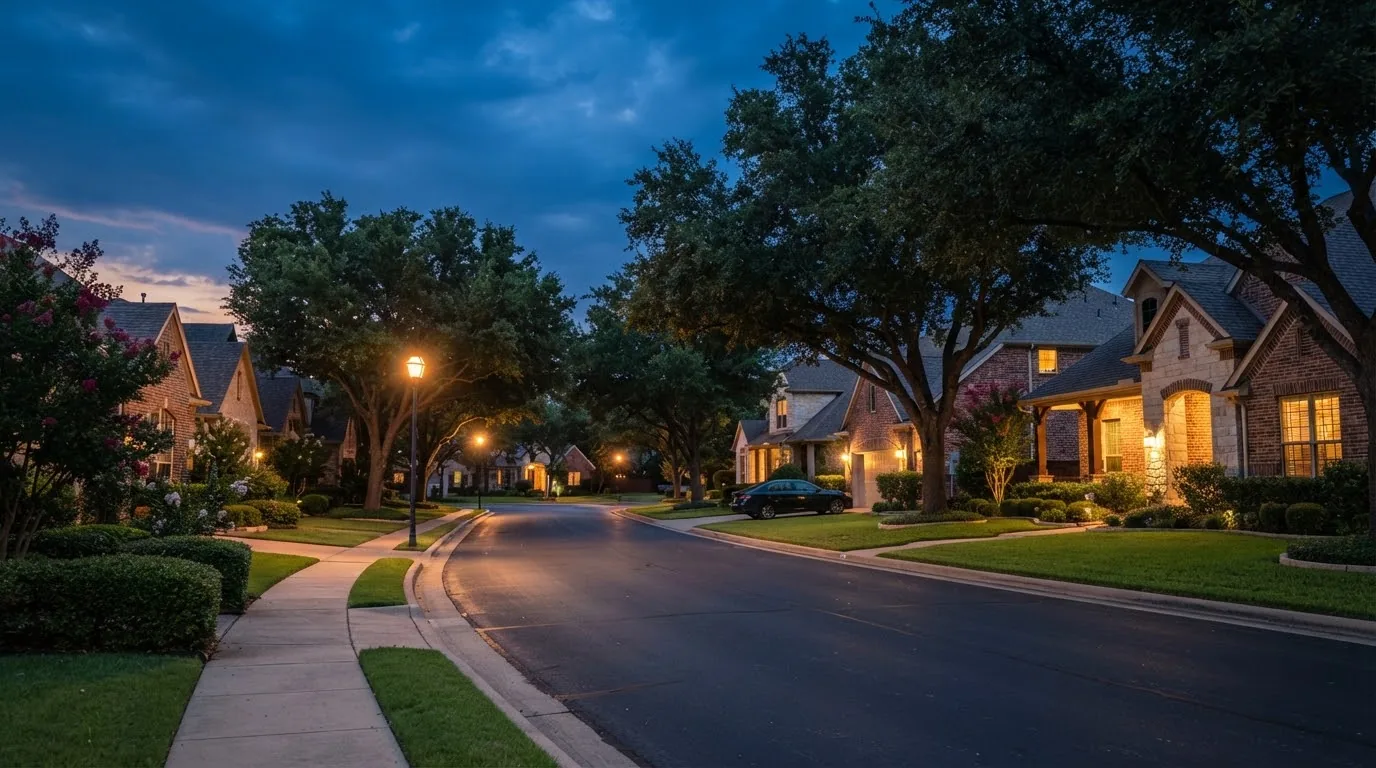
Fort Worth has the newest housing of the North Texas cities on this network — a median build year of 1994 — and it is more owner-occupied than Dallas, at 43.0% rented against Dallas’s 57.6%. More single-family homes, fewer building managers, and newer floor systems that carry fluid differently than the older stock further east.
Where household waste can go — and where this cannot
The published not-accepted list names “Medicines & Medical waste”, so biohazard material cannot go there.
Facility
Fort Worth Environmental Collection Center
Address
6400 Bridge St., Fort Worth, TX 76112
Hours
Thursday and Friday 11 a.m.–7 p.m., Saturday 9 a.m.–3 p.m.
Arlington, Tarrant County and dozens of other entities feed into this one facility. Proof of residence required.
Texas excludes household waste from the medical-waste rules, so a family clearing a home is not
breaking them. That is a point about waste law, not about safety: blood and body fluids carry
bloodborne pathogens, they soak into materials that look dry, and this is work for someone with
protective equipment and training. The drop-offs refuse the material anyway, and a contractor
hauling it needs a TCEQ transporter registration under 30 TAC 326.53.
Check a company in the TCEQ registry
Fort Worth by neighborhood improvement program areas
The city publishes 11 neighborhood improvement program areas.
Fort Worth also lists hundreds of registered neighborhood associations, but that roster dates from 2020; these eleven are current.
New MitchellFairhavenWorth HeightsSeminaryHistoric MarineLas Vegas TrailComoRosemont AreaNorthside AreaAsh CrescentStop Six
These offices help victims and families directly, and none of them will try to sell you anything.
Fort Worth Police Department — Victim Assistance Section817-392-4390
Tarrant County Criminal District Attorney — Victim Services817-884-2740
The Texas Crime Victims’ Compensation Program pays up to $2,250 toward crime-scene
cleanup for crimes after July 14, 2016, and it pays last — after any homeowners’ or
renters’ insurance. It applies to violent crime, not to an unattended natural death, and it
does not cover structural repairs. Claims run within 3 years of the crime, unless good cause can be shown for the delay.
Program rules
The questions below are the ones worth asking any company before it starts work in Fort Worth.
The local detail — which office releases the scene, which number to call, what the housing here
means for the job — is set out above, with its sources.
How to choose a provider in Fort Worth
Confirm the company serves Fort Worth, and ask for an arrival window in writing rather than a promise on the phone.
Ask whether technicians are trained under the OSHA Bloodborne Pathogens standard, and whether there is a written exposure control plan.
Ask how regulated medical waste is transported and disposed of, and whether their transporter is registered with the TCEQ — you can look the registration up by name.
Ask whether they bill homeowners or renters insurance directly, and get the scope and price in writing before work starts.
Ask whether they use unmarked vehicles and how they protect your privacy.
Ask how they verify the job is finished — ATP testing, odor checks, or a post-clean walkthrough.
Ask where the material will actually go. Fort Worth's own household drop-off refuses it, so a contractor has to haul it — which is the TCEQ registration question above, made concrete.
Ask whether they have worked a case under Fort Worth City Code § 11A-26. A property left untouched in Fort Worth becomes a code-compliance matter, not just a private one.
Ask who they will deal with at the Tarrant County Medical Examiner’s District, and whether they will wait for the property to be released before anyone enters.
How it works
Getting help in Fort Worth
01
Call or request a callback
Tell us what happened and where in Fort Worth. The call is confidential and there is no obligation.
02
Get connected in Fort Worth
We look for a company that serves Tarrant County, and tell you plainly if we do not have one.
03
Assessment and written estimate
Get the scope and the price in writing after someone has seen the property. Ask whether they will bill your insurer directly.
County
Tarrant County
Dallas–Fort Worth
Residents
about 919,000
Fort Worth, TX
Services covered
6
Biohazard, crime scene, death, hoarding, odor
Cost to you
Free
We are paid by providers, not by families
Providers serving Fort Worth
No company has finished our checks in Fort Worth yet, so there is nothing here we would stand behind.
We would rather show you that than a list we cannot vouch for.
Call (866) 697-0754
or leave your number and we will tell you plainly what we can and cannot do for your address today.
The checks a company has to pass are published in full.
The Tarrant County Medical Examiner’s District, on 817-920-5700. It examines and releases the person; it does not clean the property, and neither does the police department or the fire service. That falls to the property owner or the next of kin.
How long does the Tarrant County office take?
Its published wording is: “Bodies brought to the Medical Examiner’s Office are generally ready for release to a funeral home or crematorium within 24 hours, although rarely, a body is held longer for legal purposes.” Funeral home releases are weekdays only, 7 a.m. to 3 p.m. There are no weekend or holiday releases.
What do I call in Fort Worth if it is not an emergency?
817-392-4222. The contact page lists 817-392-4222 to report a non-emergency, the main line 817-392-4200 at 505 W. Felix St, listed for 8:00-5:00 Monday to Friday, and 817-392-3900 at 501 Jones St for after 5:00 PM and on weekends. Anything in progress is still 911.
Can I take the material to a Fort Worth drop-off myself?
No. The published not-accepted list names “Medicines & Medical waste”, so biohazard material cannot go there. Texas rules do not treat household waste as medical waste — 30 TAC 326.3(23) excludes “waste from single or multi-family dwellings” — but that is waste law, not a safety opinion. Blood and body fluids carry bloodborne pathogens and soak into materials that look dry, so this is work for someone with protective equipment and training. The drop-offs refuse the material anyway, so it has to leave with a contractor. A company hauling it needs a TCEQ transporter registration under 30 TAC 326.53, which you can check in the TCEQ Central Registry.
It happened in a rented home in Fort Worth. Who pays?
Start with the lease and the insurer, not with an assumption. Under Texas Property Code § 92.052, the Texas Attorney General puts it this way — Unless the need for repair was created by “normal wear and tear,” the landlord does not have a duty to repair problems caused by you, another lawful occupant, a member of your household, or your guests. — which means the landlord's usual duty to repair does not automatically cover damage caused by a member of the household. It matters here: 43% of occupied homes in Fort Worth are rented.
Does a cleanup company in Texas need a license?
Not for this work. The Texas Department of Licensing and Regulation publishes the state’s licensed trades. Mold assessors and remediators are licensed, and so are sanitarians and code enforcement officers — but there is no license for crime-scene, biohazard, trauma-scene or unattended-death cleanup itself. So a company advertising a Texas cleanup license is describing something that does not exist. If mold is part of your job a mold remediation license is real and worth asking for; otherwise ask about insurance, bloodborne-pathogens training and where the waste goes.
How much does biohazard cleanup cost in Fort Worth?
Companies commonly advertise $1,000 – $10,000+ for this work, and we publish that band because it is what the trade publishes — not because we have verified it. Nobody can price a job before they have lifted a floor covering and seen how far the fluid travelled. Get a written estimate after an on-site assessment, and ask whether the company will bill your insurer directly.
Is there help with the cost after a crime?
The Texas Crime Victims’ Compensation Program pays up to $2,250 toward crime-scene cleanup for crimes after July 14, 2016. It applies to violent crime — not to an unattended natural death — it does not cover structural repairs, and by law it pays last: “By law, the program is a last-resort option. If you qualify for compensation from other sources, like homeowners’ or renters’ insurance, that must be used before the CVC Program.” Claims run within 3 years of the crime, unless good cause can be shown for the delay. The Attorney General's crime victim line is (800) 983-9933.
You don't have to handle this alone.
Call or leave your number about a property in Fort Worth and we'll tell you plainly what we can and cannot do for your address today.